
How We’re Planning Three Months in Europe With Four Kids
Planning a trip to Europe with kids is one thing.
Planning to move a family of six there for a few months is something completely different.
Before we started planning the logistics, we had to make the much bigger decision of whether taking our four kids to Europe for three months actually made sense for our family.
Once we officially decided we were doing this, I quickly realized there wasn’t going to be one giant checklist that magically got us from Philadelphia to Tuscany.
There were flights to figure out. Places to live. Transportation between cities. School. Luggage. Winter clothes. Food. Insurance. Phones. Weekend trips.
And because there are six of us—including two very young kids—some of the advice that works perfectly well for a couple traveling around Europe doesn’t necessarily work for us.
So instead of trying to plan the entire trip at once, we’ve been solving one problem at a time.
Here’s how we’ve approached it so far.
Table of Contents
Flights Were the First Puzzle
The first thing I started researching wasn’t what we’d do once we got to Tuscany.
It was how the heck we were going to get six people from Philadelphia to Italy.
Traveling internationally with four kids changes the way you look at airfare.
I wasn’t simply searching for the cheapest ticket from Philadelphia to Italy. I was trying to solve a much bigger puzzle.
Do we buy round-trip tickets?
One-way tickets?
Would a multi-city itinerary make more sense since we weren’t necessarily going to come home from the same country we flew into?
Could I use our American Airlines points?
And then there was the question of where six of us should actually sit for an overnight flight to Europe.
Economy, Premium Economy or Business Class?
Economy would obviously be the least expensive option.
But we’re talking about an overnight transatlantic flight with four kids, so I started looking closely at Premium Economy.
Would the additional space and comfort be worth spending more points for six seats?
For us, the answer was yes.
Business Class didn’t make much sense for the flight to Europe.
Besides requiring significantly more points, lie-flat Business Class seats are designed to give each passenger their own individual space.
That sounds fantastic for adults.
It’s considerably less useful when one of your passengers is two years old.
I’m not particularly interested in putting a toddler in her own little Business Class cubby on an overnight flight and hoping everyone gets some sleep.
For the flight over, Premium Economy felt like the sweet spot.
More comfortable than Economy without separating everyone into individual spaces or using a ridiculous number of points.
Why Nonstop Flights Matter When Traveling to Europe With Kids
Another thing became clear pretty quickly:
If we could avoid connecting flights with four kids, we would.
Every connection means getting everyone off one airplane, moving through another airport, finding another gate and getting everybody back onto another plane.
Then add all the luggage we’ll need for several months, carry-ons and a stroller.
No thanks.
The problem was that there wasn’t a nonstop option from Philadelphia to Florence that worked for us.
So instead of adding a connection just to get closer to Pistoia, we started looking at Rome.
And that ended up working out better than we expected.
We Let the Points Choose Our Departure Date
Because I had American Airlines points available, I started searching award availability instead of deciding that we absolutely had to leave Philadelphia on one particular date.
That flexibility made a huge difference.
I found one-way Premium Economy award seats from Philadelphia to Rome at a points price that made sense for us.
There was just one catch.
The date would put us in Italy about eight days before we needed to be in Pistoia.
Our solution was pretty simple:
Spend eight days in Rome.
There are worse problems to have.
Instead of picking an exact departure date and then paying whatever it cost in points to put six people on that particular flight, I searched around our general travel window.
The award pricing helped choose the date.
And suddenly, eight days in Rome became the beginning of our European detour.
That’s probably one of the biggest lessons I’ve learned from planning the flights:
When you’re using airline points for six people, flexibility can be incredibly valuable.
We Didn’t Book a Traditional Round Trip
Once Rome was figured out, I stopped thinking about this as a traditional round-trip vacation.
Our trip is essentially:
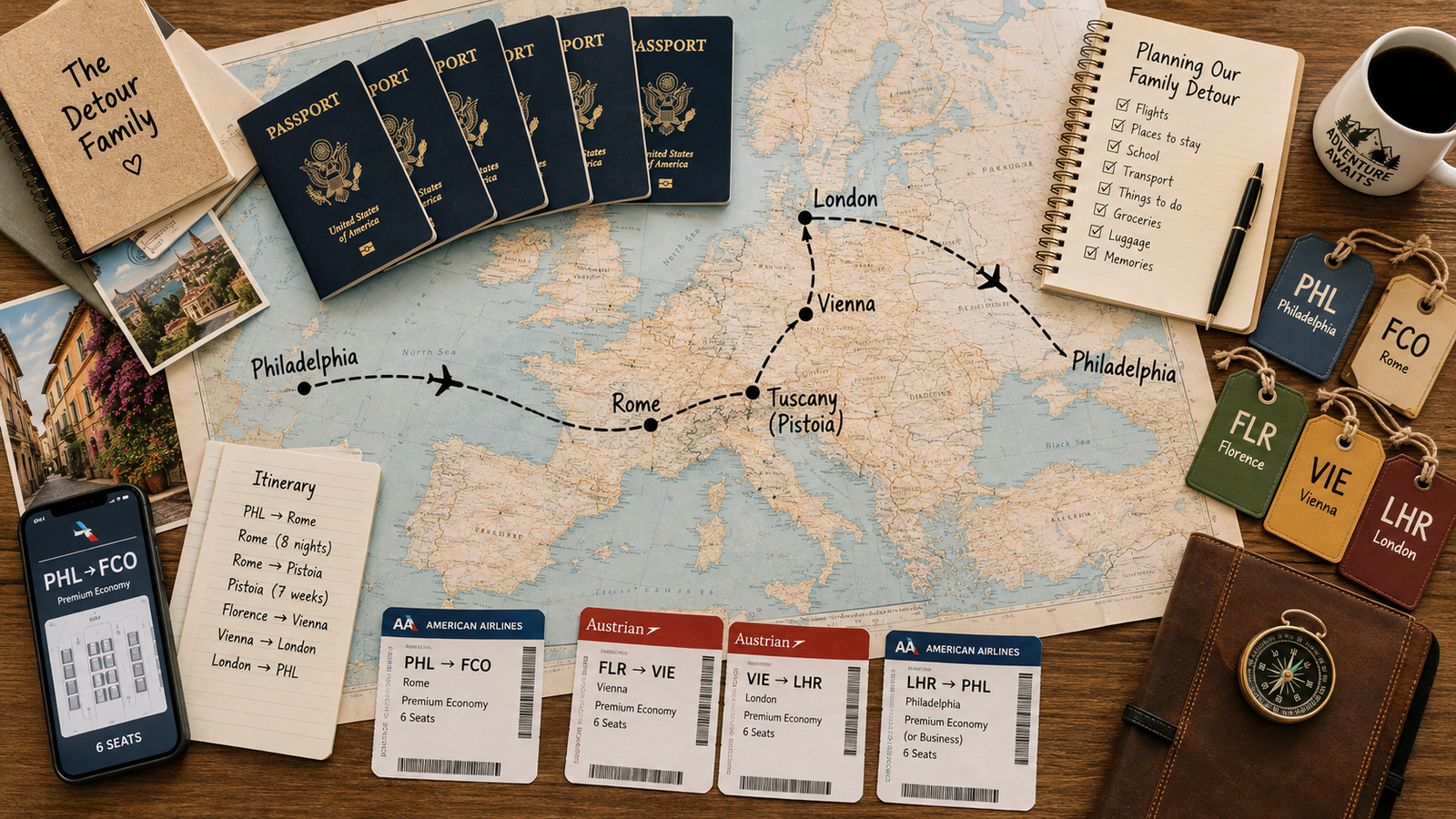
Philadelphia → Rome → Pistoia → Vienna → London → Philadelphia
We’ll fly one-way from Philadelphia to Rome in Premium Economy using American Airlines points.
We’ll spend eight days in Rome before heading to Pistoia, where we’ll settle into our home for the main part of the trip.
When our time in Tuscany ends, we’ll leave from Florence and fly to Vienna on Austrian Airlines.
From Vienna, we’ll continue on to London.
And then we’ll eventually fly one-way from London back to Philadelphia on American Airlines.
I say eventually because that last flight has already taught me another lesson about traveling with points.
Our Flight Home May Actually Extend the Trip
Originally, the plan was to fly from London back to Philadelphia in Premium Economy.
Then I checked the American Airlines award calendar again.
Business Class award pricing for a later date had dropped dramatically.
Enough that we may be able to put all six of us in Business Class for fewer points than some of the other options we’d been considering.
There’s just one catch.
We’d have to stay in London for two additional days.
I think we’ll survive.
If the award availability continues to work, we’ll get two extra days in London and fly Business Class home to Philadelphia for fewer points.
That’s pretty much the best of both worlds.
And interestingly, it’s the same strategy that gave us our eight days in Rome.
On the way over, flexible dates helped us find the Premium Economy award seats we wanted and resulted in an extra stop in Rome.
On the way home, flexibility may give us two more days in London and a Business Class flight home.
It’s definitely convinced me that I shouldn’t stop looking at award prices just because I think I’ve figured out the itinerary.
Moving Six People Changes the Transportation Equation
Getting to Europe is only half the battle.
Once we’re there, we still have to move six people—and everything we’re bringing with us—from place to place.
That’s why we’re planning to use quite a few private cars and minibuses.
I know what you’re thinking.
What about the trains?
Believe me, I’ve researched them.
Everything I’ve read says the train system in Italy is excellent. For two adults traveling with a couple of suitcases, I’d probably be all over it.
But that’s not our situation.
We’re going to have four kids, large suitcases, carry-ons and a stroller.
Getting everyone and everything out of an Airbnb, onto a train, through a station, off the train and then to the next place doesn’t sound like the beginning of a relaxing travel day to me.
Could we do it?
Absolutely.
Do I particularly want to?
Not really.
So we’re making a conscious decision to spend more money in certain places if it makes the logistics significantly easier.
That’s becoming one of my philosophies for this trip:
We’re not trying to travel as cheaply as humanly possible. We’re trying to spend money where it makes traveling with four kids significantly easier.
Hotels Don’t Really Work for Us Anymore
Accommodations present another challenge.
As a family of six, hotels just aren’t a great option for us anymore.
We’d often need multiple rooms, and then we’d have to worry about whether they’re connecting, how everyone is sleeping and whether we’re actually gaining anything by staying in a hotel.
So we constantly find ourselves turning to Airbnbs and vacation rentals.
For a trip this long, having an actual home becomes even more important.
Our wish list is pretty specific.
We generally want at least three bedrooms and two bathrooms.
We want a kitchen.
We need heating for a winter trip, and air conditioning is something I always pay attention to for warmer trips.
A washer is a must when six people are living somewhere for an extended period.
And with our younger girls, having some outdoor space is a huge bonus.
But I’ve learned that what’s outside the Airbnb can be just as important as what’s inside it.
I Spend a Lot of Time Looking at Maps
I probably spend almost as much time studying the map around an Airbnb as I do looking at pictures of the actual property.
A beautiful house isn’t particularly useful to us if it’s in the wrong location.
How walkable is the neighborhood?
Where’s the grocery store?
Can we get coffee nearby?
Where are the restaurants?
Are there markets?
What can we reasonably walk to with the kids?
For this trip especially, I don’t want us getting into a car every single time we need something.
We’re going to be living in these places, not simply sleeping there.
And our Airbnb search in Rome is a perfect example.
Why We’re Staying in Monti in Rome
For our eight days in Rome, I wanted somewhere that felt like we were actually staying in Rome.
We chose Monti.
We love farmers markets, neighborhood restaurants and being close to everything without necessarily staying right in the middle of the busiest tourist areas.
I want to be able to walk outside in the morning, get a cappuccino, find something to eat and wander through an actual neighborhood.
But choosing our Rome Airbnb involved another consideration I never would have thought much about on a normal vacation:
Rome’s ZTL zones.
These are restricted traffic areas where vehicle access is controlled.
That matters quite a bit when your plan involves private transportation.
When we eventually leave Rome for Pistoia, we’ll have six people, months’ worth of luggage, carry-ons and a stroller.
The last thing I want to discover is that our transfer vehicle can’t get anywhere near our Airbnb.
Dragging everything through Rome for five or ten minutes just to reach our minibus isn’t particularly appealing.
So I paid close attention to the ZTL boundaries while researching properties.
We wanted the neighborhood experience of Monti while staying close enough to the edge of the restricted area that our private transfer to Pistoia could pick us up nearby.
It’s a tiny detail.
But I’m learning that when you’re traveling with six people, tiny details can make a huge difference.
We Chose Our Own Villa in Pistoia
Boundless Life offers housing, so staying in one of their homes certainly would have been an option.
But we decided to look ourselves.
Eventually, we found a villa in Pistoia that checked the boxes that mattered most to us.
One of the biggest advantages is that it’s walkable to the girls’ school.
We’re expecting the walk to take roughly 15–20 minutes.
And strangely enough, that walk is one of the parts of this whole experience I’m looking forward to most.
I can picture us walking the girls to and from school, stopping for a cappuccino, finding some gluten-free baked goods or grabbing gelato on the way home.
We’ll also be close to farmers markets, grocery shopping and the center of town.
That’s exactly the type of experience we’re hoping for.
I don’t want to move our family to Italy for a few months just to recreate the exact same routine we have at home.
We want to walk through Pistoia and actually live there for a while.
Walkability Became More Important Than I Expected
The more I’ve planned this trip, the more I’ve realized how important location is going to be.
A rental could have an incredible kitchen, another bedroom or a beautiful view.
But if we’re constantly relying on transportation to get six people anywhere, those advantages start to matter less.
Being able to walk out the door and get groceries matters.
Being able to walk to school matters.
Being able to stop for coffee matters.
Being able to walk into the center of town for dinner matters.
For a one-week vacation, I might make different compromises.
For somewhere we’re going to call home for a while, walkability moved way up the list.
We’re Planning for Real Life, Not Three Months of Vacation
I think that’s probably the biggest difference between planning this trip and planning most of our previous vacations.
We’re not trying to plan three months of vacation.
That would be exhausting.
We’re trying to plan a temporary version of normal family life in Europe.
There will be school mornings.
There will be grocery shopping.
There will be laundry.
There will be work.
There will be days when nobody wants to tour another church or museum.
I’m sure there will be rainy days when we stay home.
And with four kids, I’m certain there will be days when whatever I carefully planned goes completely out the window.
That’s okay.
Part of the reason we’re doing this is because we don’t want to race through Europe checking destinations off a list.
We want to slow down enough to experience what living there actually feels like.
We Definitely Don’t Have Everything Figured Out
We’re still planning.
There are packing lists to build.
Clothes to buy.
Transportation to finalize.
Restaurants to research.
Weekend trips to plan.
And probably a thousand little questions I haven’t even thought of yet.
But that’s also why I started The Detour Family before we left.
I don’t want to write about this trip six months afterward and make it sound like everything went perfectly.
I want to document how we’re actually planning it.
What we’re researching.
What we’re booking.
What we’re buying.
Where we’re spending more money.
Where we’re saving it.
What we’re worried about.
And why we’re making the decisions we’re making.
Then, once we’re actually there, I’ll be able to tell you something much more useful:
What worked—and what didn’t.
Because I’m almost certain some of my carefully researched plans are going to look completely ridiculous once four kids are actually standing in the middle of Europe with us.
And those might end up being the best stories.
Taking the Detour
The more pieces of this trip we put together, the more real it becomes.
Six one-way tickets to Rome.
Eight days exploring the city.
A villa in Pistoia.
Walking the girls to school in Tuscany.
Weekend adventures.
Vienna.
London.
Maybe two bonus days in London because airline award pricing worked in our favor.
And eventually a flight home to Philadelphia—possibly with six Business Class seats if the points cooperate.
There are certainly easier ways to spend a winter.
But that’s kind of the point.
We have a normal life at home that we love, and eventually we’ll return to it.
For a little while, though, we’re taking the longer route.
We’re taking the family detour.
2 Comments